This is the first question every farmer asks, and it is the right one. Additional income from your land sounds good, right up until you realize it has to come from the same plot that supports you today. If the crops are harmed, the whole calculation is turned upside down.
The answer is not “nothing happens”. Something does change, and in some cases it changes for the worse. The practical question is what exactly changes, what is within the control of the design, and how each crop responds.

What Is an Agrivoltaic System?
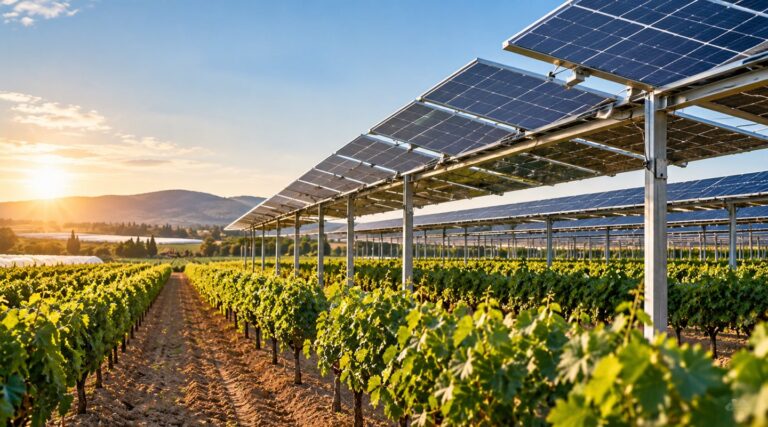
According to the definition of the Agricultural Planning and Land Division at Israel’s Ministry of Agriculture, an agrivoltaic facility is a photovoltaic facility integrated with agricultural activity throughout the entire lifetime of the facility. These are facilities located above crop farming in open fields (field crops, orchards and vineyards), as opposed to panels on greenhouse roofs or over water reservoirs.
This distinction matters. A system on a greenhouse roof sits on top of a structure. An agrivoltaic system sits above the ground itself, and the crop keeps growing underneath it.
What Partial Shading Does to a Field
A panel blocks sunlight. That is a fact, and there is no way around it. What actually happens is more complex, because sunlight is only one of the factors that limit crop growth in Israel.
Under a panel array, the temperature drops. A systematic review of studies on agrivoltaic systems found a decrease of 1 to 4 degrees Celsius in air and soil temperature, and a 20 to 47 percent improvement in water use efficiency. In a field that suffers from heat stress and high evaporation, less direct radiation during the harshest hours of the day does not necessarily work against you.
But this is not true for every crop. Among the challenges in the field, the Ministry of Agriculture explicitly lists reduced output per unit of land and lower profitability due to shading and support posts in the field. A crop that needs full sunlight will yield less. The exact wording in the Ministry’s documents is optimizing for a crop that will “benefit” from shaded conditions, meaning that crop selection is part of the design, not a given you can take for granted.
A large-scale pilot is currently under way in Israel, designed to answer exactly this question: 119 plots, 32 different crops, 9 soil types and 10 technologies, with the participation of 21 companies and 33 researchers from 11 institutions. Each plot is monitored for meteorological, agricultural, energy and environmental parameters, compared with control plots. Research funding in the field stands at about 13 million shekels.
Read more in the Agricultural Planning and Land Division presentation (Hebrew)

Height Determines Whether You Can Keep Working
This is the part that surprises farmers more than anything else. The main challenge of an agrivoltaic system is not the light. It is the structure.
The Ministry of Agriculture lists this as a declared operational challenge: spraying, pruning, irrigation and plowing become more difficult because of the height and density of the structure. Accordingly, structural plans for agrivoltaic facilities are required to ensure a minimum height of 4.5 meters, to maintain flexibility in changing crops, replanting and crop rotation, and to allow continued work with agricultural machinery.
The coverage rate is also limited. The work is carried out in stages, within a range of 30 to 50 percent coverage, rather than full coverage of the plot.
In practice, the three questions that determine whether the system will work in your field are: can the tractor get through, will we be able to switch crops in five years, and how much growing area will be lost to the support posts.

Farming Must Continue, and It Is Enforced
There is a point here worth knowing before you sign. An agrivoltaic project is not a conversion of farmland into a solar field. Agricultural activity is a condition for its existence.
Supervision and monitoring of the parallel agricultural use are carried out by the Ministry of Agriculture. If the Ministry determines that the land has not been used for agriculture for two consecutive years, or for a cumulative period of three years taking crop cycles into account, the plan expires. The non-agricultural uses approved under it become prohibited land uses within six months, even if building permits were lawfully issued.
In other words, a crop that is neglected after installation is not just a loss of yield. It is a risk to the entire facility.
How to Choose Right from the Start
Matching the crop, the soil and the facility is work done before installation, not after. It includes reviewing the existing crop and the crops you may want to grow in the future, the soil type, the irrigation regime and the machinery you actually work with. Alongside it runs the planning and licensing process with the local planning committee, the Israel Land Authority and the Ministry of Agriculture.
This is exactly where a company that knows the agricultural sector stands apart from a company that specializes in rooftops. At Rotem Energy, our in-house engineering team designs the structure around your cultivation needs, and we accompany the process with the authorities and the Israel Electric Corporation, from the initial survey through grid connection and ongoing monitoring.
Learn more about agrivoltaic systems
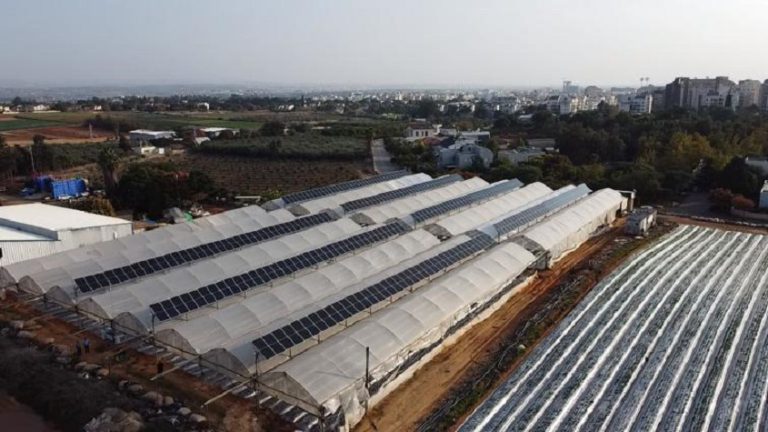
Greenhouse growers face entirely different questions, because there the system sits on an existing structure rather than above the ground.
Learn more about solar systems on greenhouses
Frequently Asked Questions
Do crops get enough light under the panels?
It depends on the crop and the coverage rate. Plans for agrivoltaic facilities work in stages of 30 to 50 percent coverage, so a significant share of the sunlight still reaches the ground. A crop that requires full sunlight will yield less, which is why crop selection is part of the design.
Can you keep working with a tractor and farm machinery?
Yes, and it is an explicit requirement. Plans for agrivoltaic facilities must provide a minimum height of 4.5 meters and allow continued work with agricultural machinery, along with flexibility in changing crops, replanting and crop rotation.
Does an agrivoltaic system save water?
A systematic review of studies in the field found a 20 to 47 percent improvement in water use efficiency, along with a decrease of 1 to 4 degrees in air and soil temperature. Actual results vary from crop to crop and from region to region.
What happens if you stop cultivating the land after installation?
If the Ministry of Agriculture determines that the land has not been used for agriculture for two consecutive years, or three cumulative years, the plan expires and the uses approved under it become prohibited within six months. Agricultural activity is a condition for the facility’s existence.
Want to know whether your crop and your cultivation regime are suitable for a system above the field? An on-site suitability check reviews the crop, the soil and the machinery you work with, before any structure is designed.
You are welcome to contact us for specific information about a solar system for you
Call us at *8426 or leave your details, you can also reach us on WhatsApp